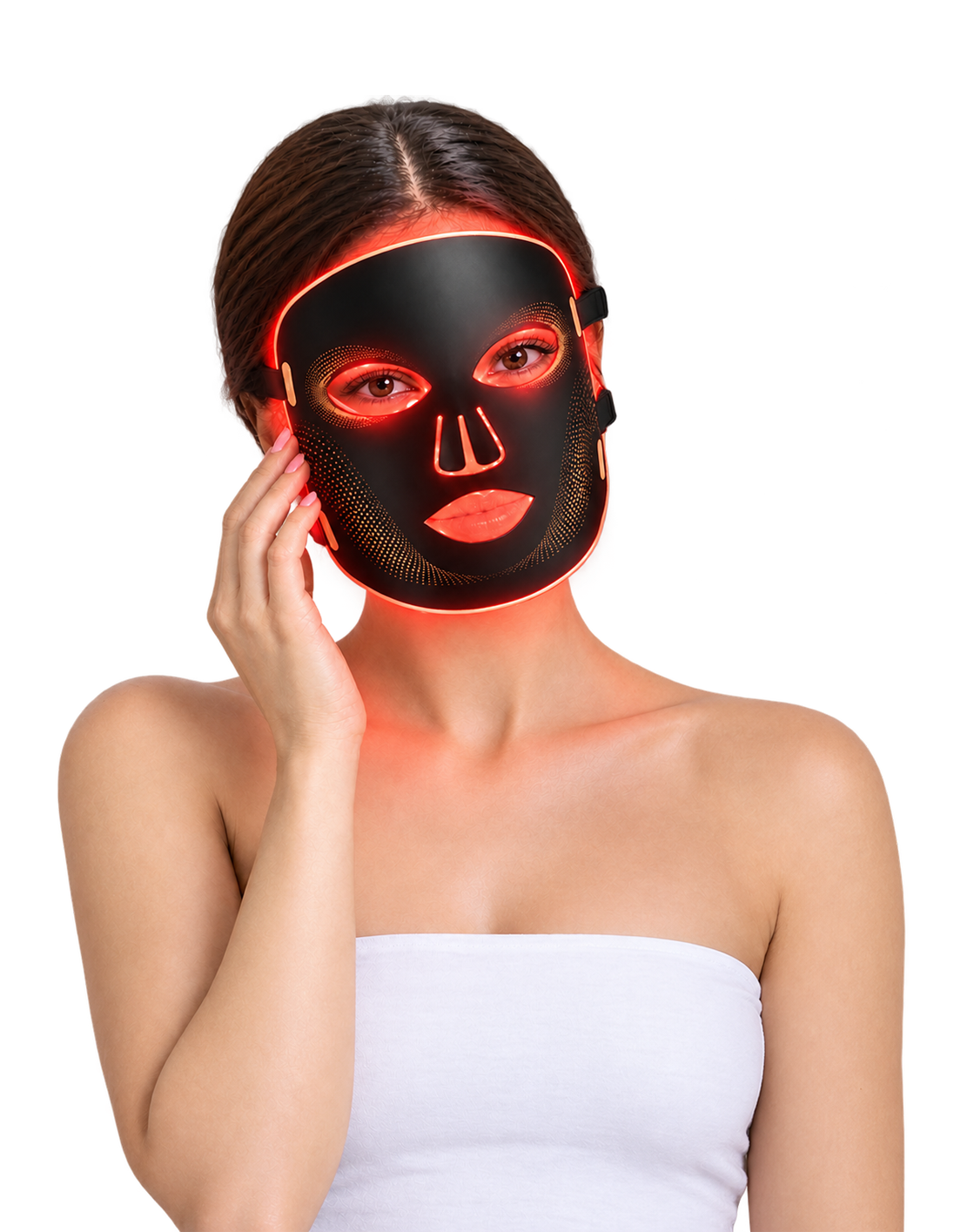
Red light devices have moved from dermatology clinics to bathroom shelves in a few years. The marketing has moved faster than the science, so it helps to know exactly what has been shown and under what conditions.
The mechanism, briefly
Red light around 630 to 660 nm and near-infrared around 810 to 850 nm pass a few millimetres into skin, where they are absorbed by cytochrome c oxidase in mitochondria. The proposed effect is a temporary boost in cellular energy production and signalling that, repeated over weeks, encourages fibroblasts to make more collagen and reduces some inflammatory signals. This is called photobiomodulation. It involves no UV and no heating of tissue, which is why it is safe to use often.
The trial worth knowing
The most cited controlled study is by Wunsch and Matuschka, published in Photomedicine and Laser Surgery in 2014. It randomised 136 volunteers, 113 into four treatment groups and 23 controls. Treated participants had two sessions a week for 30 sessions of red or red-plus-near-infrared light at roughly 9 J/cm². Compared with controls, they showed statistically significant improvement in blinded assessments of complexion, in profilometry-measured skin roughness, and in collagen density measured by ultrasound. Participants also rated their own skin as improved.
Two caveats are fair. The study used professional panels at a controlled dose, and 30 sessions is about three months of commitment. Home devices vary widely in output, and a panel that is too weak or held too far away delivers a fraction of the dose. Reviews of the wider literature, such as Avci and colleagues in 2013, find the direction of evidence consistent but call for larger trials.
Getting a real dose at home
Dose is irradiance multiplied by time. A panel delivering around 60 mW/cm² at 15 cm gives roughly 36 J/cm² in ten minutes, comfortably in the range used in studies; the same panel at 40 cm delivers far less. So keep the distance the manufacturer specifies, use clean bare skin so nothing blocks the light, and be consistent: three to five sessions a week for at least eight weeks before judging.
Safety rules
Wear the goggles; the light is very bright even though it does not harm skin. Do not use if you are pregnant, purely because it has not been studied. Skip it if you take photosensitising medication such as certain antibiotics, isotretinoin or St John's wort, if you have a photosensitivity condition such as lupus, or over an area with active skin cancer or an open wound, unless a doctor has said otherwise. Stop if you get more than a brief pink flush. None of this makes the device dangerous; it makes it a device to use as directed.